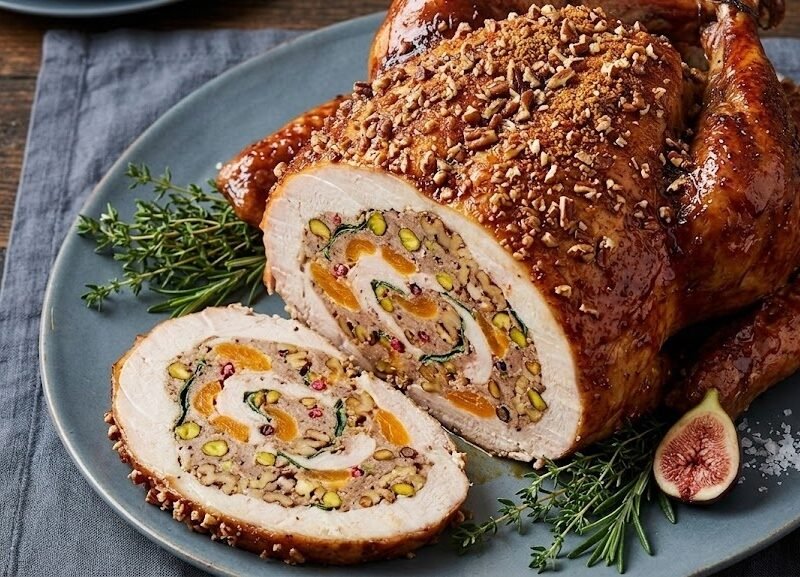
This classic stuffed roast turkey is everything you want on a holiday table: crisp, deeply golden skin, juicy slices of breast meat, and a buttery herb stuffing that soaks up all the best pan flavours. It’s a confident, traditional bake that feels special without being fussy, as long as you use a thermometer and give the bird plenty of resting time. Difficulty is intermediate, mostly because of timing and temperature checks. Total time is around 4 hours 15 minutes, including resting (a little longer for very large turkeys).
Ingredients
For the turkey
- 1 whole turkey (5 to 6 kg), fully thawed
- 2 tsp fine sea salt, plus extra to season
- 1 1/2 tsp freshly ground black pepper, plus extra to season
- 1 lemon, halved
- 1 large onion, quartered
For the herb butter
- 120g unsalted butter, softened
- 2 tbsp fresh parsley, finely chopped
- 1 tbsp fresh sage, finely chopped
- 1 tbsp fresh thyme leaves, chopped
- 2 garlic cloves, finely grated
- Pinch of salt and pepper
For the stuffing
- 450g day-old bread, cut into 2cm cubes
- 450g pork sausage meat
- 80g unsalted butter
- 1 large onion, finely diced
- 3 celery sticks, finely diced
- 2 tbsp fresh parsley, finely chopped
- 1 tbsp fresh sage, finely chopped
- 1 large egg, lightly beaten
- 350 to 500ml chicken or turkey stock, added gradually
- Salt and pepper, to taste
For roasting
- 750ml chicken or turkey stock (for the roasting pan, top up as needed)
- 2 tbsp olive oil
- 2 carrots, cut into large chunks (optional)
- 2 celery sticks, cut into large chunks (optional)
How to Make Stuffed Turkey
Oven preparation
- Prepare the oven: Preheat the oven to 200°C or 180°C fan. Place a shelf in the lower-middle of the oven so the turkey roasts evenly without the top browning too quickly.
- Set up your tray: Place a rack inside a large roasting tin. If you don’t have a rack, scatter the carrot and celery chunks in the base to lift the bird slightly.
- Dry the turkey: Remove the turkey from packaging, take out giblets, then pat the skin and cavities very dry with paper towels. Dry skin is the key to crisp, golden results.
Mixing the herb butter and stuffing
- Make the herb butter: In a bowl, mix the softened butter with parsley, sage, thyme, grated garlic, and a pinch of salt and pepper. Set aside at room temperature.
- Sauté the veg for stuffing: Melt 80g butter in a large frying pan over medium heat. Cook the diced onion and diced celery for 8 to 10 minutes until soft and sweet, not browned.
- Combine the stuffing: Tip the bread cubes into a large bowl. Add the cooked onion and celery (scrape in all the butter), sausage meat, chopped parsley, chopped sage, and the beaten egg.
- Moisten properly: Add stock a splash at a time, mixing gently, until the stuffing is evenly damp and holds together when pressed but is not wet or gluey. Season with salt and pepper.
Assembling and stuffing
- Stuff loosely: Spoon stuffing into the neck cavity first, then the main cavity, but do not pack it tight. Leave a little room for heat to circulate so it cooks safely and evenly.
- Secure the bird: Tuck the wing tips under the turkey. Tie the legs together with kitchen string.
- Season and butter: Rub the herb butter all over the turkey skin. For extra flavour, gently loosen the breast skin with your fingers and push a few spoonfuls of herb butter underneath.
- Add aromatics and stock: Put the onion quarters and lemon halves inside any remaining cavity space. Pour 750ml stock into the roasting tin (not over the skin). Drizzle vegetables (if using) with olive oil.
Baking and temperature checks
- Start hot for colour: Roast for 30 minutes at 200°C (180°C fan) to help the skin begin browning.
- Reduce and continue roasting: Lower the oven to 180°C (160°C fan) and roast until cooked through. As a guide, plan on about 35 to 40 minutes per kg for a stuffed turkey, but always use a thermometer.
- Protect the skin if needed: If the breast is getting too dark before the turkey is done, tent the breast area loosely with foil.
- Top up the pan: Check the roasting tin every 45 minutes and add a splash of stock if the pan looks dry. This prevents burning and gives you better pan juices.
- Check for doneness safely: The turkey is done when the thickest part of the thigh reads 74°C and the centre of the stuffing also reads 74°C. If the turkey is done but stuffing is not, scoop the stuffing into a baking dish and bake until it reaches temperature.
Cooling, carving, and serving
- Rest properly: Transfer the turkey to a board and rest for 30 to 45 minutes, loosely covered with foil. Resting keeps the meat juicy and makes carving cleaner.
- Remove stuffing: Spoon the stuffing into a serving dish. If you’d like crisp edges, spread it in a shallow tray and pop it in the oven for 10 minutes while you carve.
- Carve and assemble: Carve the turkey (legs first, then breast). Serve with the stuffing and spoon over warm pan juices, or make quick gravy with the drippings if you like.
Tips
How do I keep the breast meat juicy?
Dry the skin well, rub herb butter under the breast skin, and don’t rely on time alone. Pull the turkey as soon as the thigh hits 74°C, then rest it for at least 30 minutes.
Why is my stuffing gummy or wet?
Too much stock is usually the culprit. Add stock gradually until the bread is just moistened. Also, make sure the sautéed onion and celery cool slightly before mixing so the bread doesn’t collapse.
What if the skin browns too fast?
Tent the breast area with foil and keep roasting. A hot start gives great colour, but foil is your best friend once the skin looks right.
How do I know it’s safe to eat when it’s stuffed?
Use a thermometer and check two places: the thickest part of the thigh and the centre of the stuffing. Both must reach 74°C. This is non-negotiable for a stuffed bird.
Serving Suggestions
- Cranberry sauce or a sharp chutney for contrast
- Roast potatoes or buttery mashed potatoes
- Honey-glazed carrots, Brussels sprouts, or green beans
- Warm dinner rolls and plenty of gravy
- A bright salad with citrus or mustard vinaigrette
Storage
Room temperature
For food safety, don’t leave cooked turkey or stuffing out for more than 2 hours (1 hour in a warm room). Carve and chill leftovers promptly.
Refrigerator
Store turkey and stuffing in separate airtight containers for best texture. They’ll keep for 3 to 4 days. Reheat until piping hot; add a splash of stock to keep slices moist.
Freezing
Freeze carved turkey in gravy or a little stock for the best results. Stuffing also freezes well. Wrap airtight and freeze for up to 2 to 3 months. Thaw overnight in the fridge before reheating.
Nutrition
- Calories: 650 kcal
- Carbohydrates: 28 g
- Protein: 52 g
- Fat: 36 g
- Saturated fat: 14 g
- Sodium: 980 mg
Nutrition values are estimates and will vary based on turkey size, sausage, bread, and how much stuffing and skin is served.
FAQs
Should I cook the stuffing inside the turkey or separately?
You can do either. Stuffing baked inside the bird is wonderfully flavourful, but it must reach 74°C in the centre to be safe. If you want simpler timing and crispier edges, bake it separately in a buttered dish at 180°C (160°C fan) for about 35–45 minutes.
How long does a stuffed turkey take per kg?
As a rough guide, a stuffed turkey often takes around 35–40 minutes per kg at 180°C (160°C fan) after an initial 30 minutes at 200°C (180°C fan). Ovens and birds vary, so always use a thermometer and cook to 74°C in the thigh and the stuffing.
Why do I need to rest the turkey?
Resting lets the juices redistribute so the slices stay moist. If you carve right away, juices run out onto the board and the breast can taste dry. Aim for 30–45 minutes, loosely covered.
Can I prep the stuffing ahead of time?
Yes. You can cube the bread and cook the onion and celery a day ahead. For food safety, keep raw sausage meat separate and mix the stuffing shortly before roasting, or store the fully mixed stuffing chilled and use within 24 hours.
What internal temperature should turkey be cooked to?
Cook turkey until the thickest part of the thigh reaches 74°C. If it’s stuffed, the very centre of the stuffing must also reach 74°C. A thermometer is the most reliable way to avoid undercooking or drying it out.